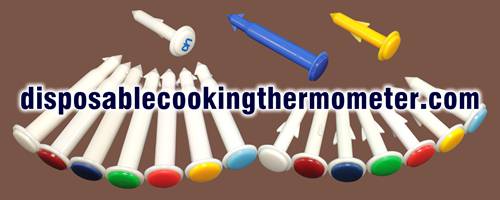
How Disposable Cooking Thermometers Support Food Safety Programs in Commercial Food Production
How Disposable Cooking Thermometers Support Food Safety Programs in Commercial Food Production
Food safety in commercial food production depends on many interconnected systems, including raw material control, processing procedures, quality inspections, and temperature management.
Among these factors, temperature remains one of the most important indicators because it directly influences cooking performance and product consistency.
For poultry processors, meat manufacturers, and ready-to-cook food companies, disposable cooking thermometers provide a practical way to communicate internal temperature conditions during the final preparation stage.
The Importance of Temperature Control in Food Production
Temperature control is a fundamental part of modern food manufacturing.
During production, companies carefully monitor conditions to maintain product quality and meet internal safety requirements.
However, many food products continue their journey after leaving the factory.
Frozen poultry, retail meat products, and ready-to-cook meals eventually depend on consumers completing the final cooking process correctly.
A reliable temperature indication solution helps connect industrial food production standards with the consumer cooking experience.
Why Internal Temperature Matters More Than Appearance
One common challenge in food preparation is that external appearance does not always accurately represent internal conditions.
The surface of a product may appear fully cooked while the center requires additional time to reach the intended temperature.
This is especially important for larger products such as:
- Whole turkey products
- Whole chicken products
- Large meat products
- Frozen poultry items
Internal temperature provides a more meaningful reference because it reflects the condition inside the product.
The Role of Disposable Cooking Thermometers in Food Safety Communication
Disposable cooking thermometers are designed to transform temperature changes into a simple visual indication.
Instead of requiring consumers to interpret cooking time alone, the product provides an additional reference point during preparation.
For food manufacturers, this creates a direct communication channel between product design and consumer usage.
Supporting Consistency Across Different Cooking Environments
Commercial food products are often prepared in thousands or millions of different kitchens.
These environments may vary because of:
- Different oven models
- Different cooking habits
- Different product handling methods
- Different preparation experience levels
A built-in temperature indicator helps reduce uncertainty by providing a consistent visual signal based on internal temperature response.
Temperature Indicators as Part of Quality Management
For food companies, temperature indication is not a replacement for professional food safety systems.
Instead, it works as one additional tool within a broader quality strategy.
Commercial manufacturers may consider temperature indication together with:
- Production controls
- Packaging design
- Cooking instructions
- Consumer guidance
- Product testing
The objective is creating a more predictable experience from production line to final consumption.
Applications in Poultry and Meat Products
Disposable cooking thermometers are commonly used in applications where consumers need clear cooking guidance.
Typical applications include:
- Turkey products
- Chicken products
- Frozen poultry
- Ready-to-cook meals
- Retail meat products
- Food service products
Different applications may require different activation temperatures and product configurations.
Why Food Manufacturers Evaluate Temperature Indicator Suppliers Carefully
Because temperature indicators become part of the finished food product, supplier selection is an important decision.
Professional buyers typically evaluate:
- Manufacturing experience
- Temperature accuracy
- Material safety
- Production consistency
- OEM capability
- Long-term supply stability
A reliable supplier helps manufacturers maintain consistent product performance across large production volumes.
Frequently Asked Questions
Are disposable cooking thermometers part of a food safety system?
Disposable cooking thermometers are a temperature indication tool that supports cooking guidance. They complement, but do not replace, professional food safety management systems.
Why do food manufacturers use temperature indicators?
They help provide consumers with clearer cooking guidance and support more consistent preparation results.
Can disposable cooking thermometers be used for frozen food products?
Yes. They can be designed for different frozen poultry, meat, and ready-to-cook applications depending on product requirements.
What makes a temperature indicator suitable for commercial use?
Commercial applications require consistent performance, suitable materials, reliable manufacturing processes, and stable supply capability.
Connecting Food Manufacturing With Consumer Confidence
A disposable cooking thermometer represents a small but important connection between food production and the final cooking experience.
For manufacturers, it provides a practical method to communicate temperature information beyond the factory environment.
As global food companies continue focusing on convenience, consistency, and consumer confidence, reliable temperature indication solutions will remain an important part of modern food product development.
Disclaimer: The term "pop up timer" has become a commonly used product description within the cooking and food industry. The products presented on this website are independently manufactured and supplied by LIOU Manufacturing – PopNReady Brand, a China-based factory direct OEM manufacturer specializing in disposable pop-up timers and temperature indicators since 2006. We have no affiliation, partnership, authorization, or business relationship with any other brand, trademark owner, or manufacturer unless specifically stated.