How to Source Food-Safe Disposable Cooking Thermometers in Bulk for Poultry and Meat Processing?
How to Source Food-Safe Disposable Cooking Thermometers in Bulk for Poultry and Meat Processing?
Food-safe disposable cooking thermometers should be sourced from manufacturers that provide verified food-contact materials, consistent activation accuracy, international compliance documentation, and scalable production capacity. For poultry processors, meat packers, supermarket private labels, and ready-meal manufacturers, selecting a qualified supplier helps improve food safety compliance, reduce operational risks, and ensure reliable cooking performance across high-volume production environments.
Why Disposable Cooking Thermometers Matter in Modern Food Processing
Food safety requirements continue to become stricter across global poultry, meat, and ready-to-eat food industries. Whether supplying fresh poultry, frozen turkey products, marinated meats, or value-added retail packaging, processors must demonstrate consistency, traceability, and compliance throughout the production chain.
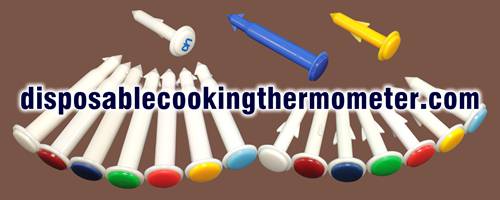
A disposable cooking thermometer, commonly known as a pop-up timer, provides a simple visual indication when a target internal temperature has been reached. Unlike reusable thermometers that require manual insertion and monitoring, disposable cooking thermometers remain embedded within the product and activate automatically during cooking.
For industrial processors, this technology delivers several operational advantages:
- Improved consumer confidence
- Reduced risk of undercooked products
- Enhanced food safety compliance
- Better consistency across product batches
- Reduced customer complaints and potential recalls
- Added value for retail-ready poultry packaging
As global food brands seek greater transparency and reliability, sourcing high-quality disposable cooking thermometers has become a strategic procurement decision rather than a simple packaging component purchase.
What B2B Buyers Should Evaluate Before Selecting a Supplier
1. Material Safety Compliance
Food-contact safety should be the first evaluation criterion. Buyers should request documentation demonstrating compliance with major regulatory standards.
A reliable disposable cooking thermometer should utilize:
- Food-grade PA66 (Nylon 66)
- BPA-Free construction
- Food-extraction temperature-sensitive wax
- Heavy-metal-free formulation
- Food-contact compliant production processes
Materials that cannot withstand roasting temperatures may deform, resulting in inaccurate activation or product quality issues.
2. Activation Accuracy
Activation temperature consistency directly affects food safety performance. Large processors require predictable activation across millions of units annually.
Low-cost suppliers often struggle with activation variation between batches. Excessive variation can create quality control challenges and increase operational risk.
Professional manufacturers should provide activation accuracy specifications and batch validation data. A tolerance of +/-2°F is generally considered a high-performance standard for commercial food production.
3. Supply Chain Stability
Many processors experience disruptions due to seasonal demand spikes, especially during holiday poultry production cycles.
Procurement teams should evaluate:
- Annual production capacity
- Export experience
- Lead-time consistency
- Raw material sourcing stability
- Quality management systems
- Long-term contract capabilities
Selecting a supplier with established export operations reduces procurement uncertainty and helps ensure uninterrupted production schedules.
Technical Specifications & Material Safety
For industrial food processors, technical specifications are often more important than marketing claims.
At PopNReady, disposable cooking thermometers are manufactured using carefully selected food-contact materials designed for stability under commercial cooking conditions.
PA66 Housing and Core Structure
The thermometer body and internal core utilize food-grade PA66 (Nylon 66), a material recognized for its excellent heat resistance, dimensional stability, and mechanical strength.
Advantages of PA66 include:
- High-temperature resistance
- Excellent dimensional consistency
- Low deformation under roasting conditions
- Strong mechanical durability during processing
- Suitable for industrial automation environments
Food-Extraction Temperature-Sensitive Wax
The activation mechanism uses food-extraction wax that expands at a predefined temperature point. This formulation contains no soft metals and no heavy metals, helping support food-contact safety requirements across international markets.
High Precision Metal Spring System
Each unit incorporates a precision-engineered metal spring that delivers reliable pop-up performance once the activation temperature is reached.
This design contributes to an activation accuracy of approximately +/-2°F, helping processors achieve greater consistency across production batches.
Compliance Certifications
Professional buyers frequently require documented compliance support. Available certifications include:
- FDA Compliance
- EU Food Contact Compliance
- BRC Standards Support
These certifications help simplify supplier qualification and procurement approval procedures.
How Disposable Cooking Thermometers Create Value for Food Brands
Beyond temperature indication, disposable cooking thermometers contribute measurable business value.
Reduced Recall Risk
Undercooked poultry remains one of the most significant food safety concerns. Reliable temperature indicators help reduce the likelihood of consumer preparation errors.
Improved Brand Reputation
Consumers increasingly value convenience and food safety assurance. Products equipped with cooking indicators often provide stronger customer confidence and improved user experience.
Operational Cost Efficiency
Reliable indicators reduce customer service incidents, complaints, and potential product replacement costs.
Support for Value-Added Packaging
Disposable cooking thermometers are widely used in:
- Whole chicken packaging
- Turkey products
- Marinated poultry
- Ready-to-cook meat products
- Retail private-label food brands
- Frozen food applications
Why Source from PopNReady (The Direct Factory)
Choosing a direct-source manufacturer can significantly improve procurement efficiency.
PopNReady has focused exclusively on disposable pop-up timers and disposable cooking thermometers since 2006.
Unlike trading companies that source from multiple factories, PopNReady operates as a specialized manufacturing partner dedicated to a single product category.
Advantages include:
- Factory direct pricing
- No intermediary markup
- 18+ years of dedicated manufacturing experience
- 100% export-focused operations
- Stable production quality
- Long-term supply capabilities
- Professional OEM support
OEM and Customization Capabilities
For food brands and processors seeking product differentiation, PopNReady supports:
- Custom activation temperatures
- Custom colors
- Logo injection molding
- Retail blister packaging
- Private label programs
- Bulk industrial packaging
This flexibility helps procurement teams align product specifications with branding, regulatory, and operational requirements.
People Also Ask
What is a disposable cooking thermometer?
A disposable cooking thermometer is a single-use temperature indicator that automatically pops up when a preset internal temperature is reached during cooking.
Are disposable cooking thermometers food-safe?
Yes. When manufactured using compliant food-contact materials such as PA66 and food-grade temperature-sensitive wax, they are suitable for food processing applications.
What accuracy should industrial pop-up thermometers provide?
Professional-grade units should achieve approximately +/-2°F activation accuracy to support consistent cooking results.
Can disposable cooking thermometers be customized?
Yes. Manufacturers can customize activation temperatures, colors, packaging formats, and logo injection features for OEM projects.
Which industries use disposable cooking thermometers?
Poultry processors, meat packers, frozen food manufacturers, supermarket private labels, and central kitchens commonly use them.
What certifications should buyers request?
Common requirements include FDA compliance, EU food-contact compliance, and supporting documentation for BRC-related supplier approval processes.
Why buy directly from a manufacturer?
Direct sourcing reduces costs, improves communication efficiency, shortens supply chains, and provides greater quality control visibility.
Can disposable cooking thermometers support automation lines?
Yes. Stable dimensions and consistent manufacturing tolerances allow integration into many automated processing and packaging environments.
FAQ
Q: What is the typical MOQ for bulk orders?
MOQ varies depending on specifications and customization requirements. Trial orders are generally available.
Q: Can activation temperatures be customized for specific products?
Yes. Custom temperature settings can be developed for poultry, turkey, beef, pork, seafood, and specialty food products.
Q: Do you provide samples before mass production?
Yes. Sample evaluation is recommended for qualification and production validation.
Q: Can the product include our logo?
Yes. OEM logo injection and custom branding programs are available for qualified projects.
Q: Do you support global export orders?
Yes. PopNReady products are manufactured primarily for international markets and support global OEM and bulk supply programs.
Contact Factory Experts for Bulk Pricing and Samples
Looking for a reliable direct-source manufacturer of disposable cooking thermometers? Contact PopNReady today to discuss bulk purchasing, OEM customization, private-label projects, or annual supply agreements. Our factory has specialized in disposable pop-up timers since 2006 and supports global food processors, poultry plants, supermarkets, and food brands with factory-direct pricing, certified materials, and dependable large-volume production capacity.