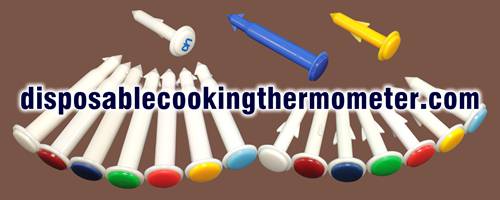
What Is a Disposable Cooking Thermometer and How Does It Work?
What Is a Disposable Cooking Thermometer and How Does It Work?
A disposable cooking thermometer is a simple but highly specialized temperature indicator designed to show when food has reached a predetermined internal cooking temperature. Unlike traditional digital thermometers that require manual measurement, a disposable cooking thermometer is placed inside the food product before cooking and provides a visual indication when the target temperature is reached.
Although many consumers recognize the familiar "pop-up" movement from turkey and poultry products, the technology behind these small devices involves careful engineering, food-contact material selection, thermal response design, and manufacturing precision.
Today, disposable cooking thermometers are widely used by poultry processors, meat manufacturers, frozen food producers, retail food brands, and ready-to-cook product companies that need a reliable way to help consumers achieve consistent cooking results.
Understanding the Purpose of a Disposable Cooking Thermometer
The primary purpose of a disposable cooking thermometer is to transform an invisible measurement—the internal temperature of food—into a simple visual signal.
During cooking, the outside surface of meat heats faster than the inside. A product may appear fully cooked while the center is still increasing in temperature. This makes internal temperature one of the most important indicators of cooking completion.
A disposable cooking thermometer helps bridge the gap between professional food safety practices and everyday consumer cooking habits by providing an easy-to-understand indication without requiring additional tools.
For commercial food manufacturers, this technology supports product consistency by giving consumers clearer guidance after the product leaves the processing facility.
How Does a Pop-Up Disposable Cooking Thermometer Work?
A pop-up disposable cooking thermometer operates through a combination of thermal and mechanical components working together.
The basic process is simple:
- The thermometer is inserted into the food product before cooking.
- Heat gradually transfers from the food into the temperature-sensitive internal material.
- When the designed activation temperature is reached, the internal mechanism releases.
- A spring-driven indicator moves upward and becomes visible.
- The user recognizes the pop-up signal as an indication that the product has reached the intended cooking temperature.
Although the visible action appears simple, reliable performance depends on precise control of every component inside the device.
The Main Components Inside a Disposable Cooking Thermometer
A high-quality disposable pop-up cooking thermometer contains several carefully engineered elements.
Food-Grade Plastic Components
The external housing and internal structural components must withstand cooking conditions while remaining suitable for food-contact applications.
Engineering plastics such as food-grade PA66 nylon are commonly selected because of their dimensional stability, strength, and resistance to temperature changes.
Temperature-Sensitive Wax Core
The temperature-responsive material is the heart of the system.
A food-extract-based wax core changes its physical characteristics as temperature increases. Once the target activation point is reached, it allows the mechanical indicator to move.
The formulation must be carefully controlled to achieve stable activation performance while meeting food-contact safety requirements.
Metal Spring Mechanism
The pop-up movement is created by a precision metal spring.
Before activation, the spring stores mechanical energy while the indicator remains locked in position. When the temperature-sensitive material releases the mechanism, the spring pushes the indicator upward.
The consistency of spring performance directly influences the reliability of the final product.
Why Food Manufacturers Use Disposable Cooking Thermometers
For commercial food producers, disposable cooking thermometers provide several practical advantages.
Improving Consumer Confidence
Many consumers do not regularly use separate food thermometers at home. They often rely on cooking time, appearance, or personal experience.
A built-in temperature indicator provides additional guidance without requiring extra steps.
Supporting Product Consistency
Food manufacturers invest heavily in producing consistent products. However, once food reaches consumers, cooking conditions can vary significantly.
Different ovens, cooking habits, and preparation methods can influence the final result.
A disposable cooking thermometer helps provide a more predictable cooking experience across different households.
Enhancing Retail Product Value
For supermarkets, private-label brands, and packaged poultry products, small functional features can influence consumer perception.
A cooking indicator communicates convenience, quality awareness, and attention to the customer's experience.
Disposable Cooking Thermometer Applications
Disposable pop-up cooking thermometers are used in many food categories, including:
- Whole turkey products
- Whole chicken products
- Frozen poultry products
- Ready-to-cook meals
- Prepared meat products
- Retail packaged poultry
- Food service applications
The exact activation temperature and product configuration depend on the application requirements, cooking method, and customer specifications.
Disposable Cooking Thermometer vs Traditional Food Thermometer
| Disposable Cooking Thermometer | Traditional Food Thermometer |
|---|---|
| Pre-installed inside the product | Requires manual insertion during cooking |
| Provides a simple visual signal | Displays numerical temperature readings |
| Designed for single-use applications | Usually reusable |
| Convenient for packaged food products | Requires consumer handling |
What Makes a Reliable Disposable Cooking Thermometer?
For professional buyers, reliability depends on much more than appearance.
Important factors include:
- Stable activation temperature
- Food-grade materials
- Consistent manufacturing processes
- Controlled component dimensions
- Reliable spring performance
- Long-term production capability
For large-scale food manufacturers, consistency across millions of units is often more important than isolated test results.
Frequently Asked Questions
Are disposable cooking thermometers accurate?
Quality disposable cooking thermometers are designed to activate within a controlled temperature range. Professional manufacturers use carefully selected materials and production controls to achieve consistent activation performance.
Can disposable pop-up timers be customized?
Yes. Depending on the manufacturer, disposable pop-up timers can often be customized with different activation temperatures, colors, packaging options, and branding requirements for OEM projects.
Are disposable cooking thermometers safe for food contact?
Disposable cooking thermometers designed for commercial food applications should use food-contact suitable materials and comply with applicable food safety requirements.
Who uses disposable cooking thermometers?
They are commonly used by poultry processors, meat manufacturers, frozen food companies, supermarkets, food service suppliers, and private-label food brands.
Choosing the Right Disposable Cooking Thermometer Supplier
For companies purchasing disposable cooking thermometers in bulk, supplier selection plays an important role in long-term product performance.
Experienced buyers usually evaluate more than price. They consider manufacturing specialization, quality systems, export experience, customization capability, and the ability to provide stable supply over time.
A reliable manufacturing partner helps ensure that every batch performs consistently from production line to final consumer use.
Disclaimer: The term "pop up timer" has become a common product description used throughout the cooking and food industry. The products described on this website are independently manufactured and supplied by a Chinese production company. We have no affiliation, partnership, or business relationship with any other brand, trademark owner, or manufacturer unless specifically stated.