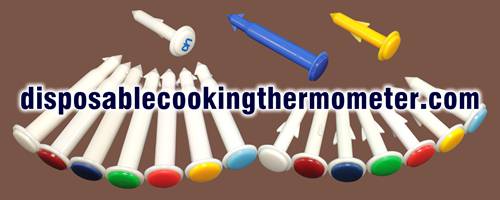
Why Food Manufacturers Choose Disposable Cooking Thermometers for Poultry Products
Why Food Manufacturers Choose Disposable Cooking Thermometers for Poultry Products
In modern food manufacturing, product quality is no longer determined only by what happens inside the processing facility.
The consumer experience after purchase has become an important part of product success.
For poultry manufacturers, one of the biggest challenges is helping consumers achieve consistent cooking results after a product leaves controlled production environments.
This is one reason why disposable cooking thermometers are increasingly used in poultry products, frozen foods, and ready-to-cook meal solutions.
From Factory Production to Consumer Preparation
Food manufacturers operate under carefully controlled conditions.
Production temperatures, processing steps, packaging procedures, and quality checks are monitored throughout manufacturing.
However, once a product reaches consumers, many variables appear:
- Different household ovens
- Different cooking habits
- Different preparation methods
- Different levels of cooking experience
A product that performs consistently in a factory environment must also provide clear guidance during final preparation.
The Challenge of Cooking Poultry Products Consistently
Poultry products require careful cooking because their size, structure, and composition can vary significantly.
Whole birds, frozen poultry items, stuffed products, and prepared meals all have different heating characteristics.
For consumers, determining exactly when a product has reached the intended internal temperature is not always simple.
This creates an opportunity for food manufacturers to provide additional cooking guidance directly within the product.
Why Built-In Temperature Indicators Add Value
A disposable cooking thermometer provides information at the exact point where consumers need it: during cooking.
Instead of requiring consumers to purchase and use separate measurement tools, the product itself provides a simple visual indication.
For food brands, this creates several advantages.
Improved Consumer Experience
Cooking uncertainty is one of the common concerns associated with poultry preparation.
A clear temperature indication helps reduce guesswork and gives consumers more confidence when preparing the product.
Product Differentiation
In competitive food categories, small functional improvements can influence purchasing decisions.
A built-in cooking indicator can help packaged poultry products stand out by offering additional convenience.
Better Brand Communication
Food packaging communicates more than product information.
It also communicates quality, reliability, and attention to customer needs.
A temperature indicator can become part of that overall product experience.
Applications in Poultry Processing
Disposable cooking thermometers are used in various poultry-related applications, including:
- Whole turkey products
- Whole chicken products
- Frozen poultry products
- Ready-to-cook poultry meals
- Retail packaged poultry
- Food service poultry products
The specific configuration depends on product requirements, cooking method, packaging design, and target market.
Why Food Manufacturers Prefer Simple Solutions
Food production often involves complex systems, but the best consumer-facing solutions are frequently simple.
A disposable cooking thermometer does not require:
- Batteries
- Electronic components
- Consumer calibration
- Additional measuring equipment
Its value comes from providing useful information through a simple mechanical and thermal process.
Supporting Private Label and Retail Food Products
Private-label food brands compete not only through pricing but also through product experience.
Retailers and food brands continuously look for ways to improve convenience and create stronger customer recognition.
A cooking indicator can support these goals by adding a practical feature that consumers can immediately understand.
For companies developing new poultry products, the ability to customize temperature indication, appearance, and packaging can provide additional flexibility.
The Role of Quality and Supply Consistency
For manufacturers purchasing disposable cooking thermometers in volume, product consistency is critical.
A temperature indicator is part of the final consumer experience, which means variations between production batches can affect brand perception.
Important supplier considerations include:
- Manufacturing experience
- Production stability
- Material control
- Quality inspection processes
- Export capability
Reliable supply allows food manufacturers to integrate temperature indicators into their products with greater confidence.
Frequently Asked Questions
Why do poultry companies use disposable cooking thermometers?
Poultry companies use them to provide consumers with easier cooking guidance and improve consistency after products leave the manufacturing facility.
Are disposable cooking thermometers suitable for frozen poultry?
Yes. They can be designed for different poultry applications, including frozen and ready-to-cook products, depending on product requirements.
Can food manufacturers customize disposable cooking thermometers?
Many commercial suppliers offer customization options such as activation temperature, color, packaging, and private-label solutions.
Are disposable cooking thermometers only useful for consumers?
No. They are also valuable as part of commercial food product design, packaging strategy, and customer experience improvement.
A Small Component With a Large Product Impact
Disposable cooking thermometers represent a connection between food engineering and consumer convenience.
For poultry manufacturers, they provide a practical way to extend quality control beyond the factory and into the final cooking experience.
As the food industry continues developing convenient, reliable, and consumer-friendly products, temperature indication technology will remain an important tool for improving consistency from production line to dining table.
Disclaimer: The term "pop up timer" has become a commonly used product description within the cooking and food industry. The products presented on this website are independently manufactured and supplied by a Chinese production company. We have no affiliation, partnership, authorization, or business relationship with any other brand, trademark owner, or manufacturer unless specifically stated.