Why Internal Temperature Matters More Than Cooking Time
Why Internal Temperature Matters More Than Cooking Time
Almost everyone has heard cooking advice like "Roast for 90 minutes" or "Bake until golden brown." For generations, time has been the easiest way to explain how food should be cooked.
Yet inside commercial food manufacturing, time has become only one variable in a much larger equation.
Today's poultry processors, meat manufacturers, ready-meal producers, and retail food brands focus on something far more important: internal product temperature.
The reason is simple. Time does not actually tell us whether food is safely cooked. Temperature does.
This distinction influences everything from food safety systems and product development to packaging design and the growing use of disposable pop-up cooking thermometers.
Cooking Time Is Only an Estimate
Recipes often recommend cooking for a certain number of minutes per pound or kilogram. While these guidelines are useful, they are based on average conditions that rarely exist in real kitchens.
Numerous factors affect how quickly food heats internally:
- Oven calibration
- Product size and shape
- Initial product temperature
- Bone-in versus boneless cuts
- Moisture content
- Air circulation inside the oven
- Packaging configuration
Even two chickens of nearly identical weight may finish cooking several minutes apart. Following time alone can therefore produce inconsistent results.
Heat Travels from the Outside In
When poultry or meat is placed in an oven, the surface temperature rises first. The center warms much more slowly because heat must gradually travel inward.
From the outside, a product may appear fully cooked. The skin may be browned and the surface may have reached a much higher temperature than the center.
However, the thickest portion of the meat may still be below the intended internal temperature.
This is why food safety professionals always pay attention to the coldest point inside the product rather than its appearance.
Why Internal Temperature Has Become the Industry Standard
Commercial food manufacturers cannot rely on appearance or cooking time alone. They require measurable, repeatable standards that can be validated during production.
Internal temperature provides exactly that.
Unlike visual inspection, temperature is objective. It can be measured, documented, verified, and repeated across production facilities around the world.
For quality assurance teams, internal temperature offers confidence that products have reached their intended cooking endpoint regardless of variations in cooking equipment or environmental conditions.
Consumer Expectations Have Changed
Today's consumers expect convenience as well as confidence.
Many home cooks no longer have extensive cooking experience, yet they still want consistent results every time they prepare poultry or meat products.
Instead of estimating doneness based on color or cooking time, consumers increasingly appreciate simple visual guidance that removes uncertainty from the cooking process.
This shift has encouraged food manufacturers to explore solutions that communicate cooking completion more clearly.
Where Disposable Pop-Up Cooking Thermometers Fit In
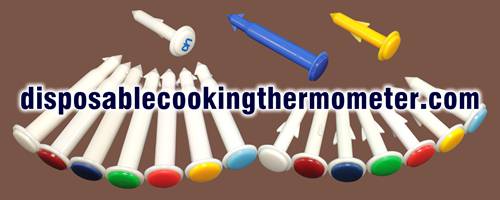
Disposable pop-up cooking thermometers were developed to translate internal temperature into an easy-to-understand visual signal.
Rather than requiring consumers to insert a separate thermometer, the indicator is already positioned inside the product during processing.
As the internal temperature reaches the designed activation point, the indicator rises automatically.
For consumers, the process feels remarkably simple.
Behind that simplicity is careful engineering involving food-grade materials, calibrated temperature-sensitive wax, precision springs, and controlled manufacturing tolerances.
The objective is not merely convenience. It is consistency.
Reducing Guesswork Improves Customer Experience
One of the greatest challenges for retail poultry products is that consumers cook them under widely different conditions.
Some ovens heat unevenly. Others operate above or below the displayed temperature. Cooking habits also vary considerably between households.
Without reliable guidance, consumers often respond by extending cooking time "just to be safe."
The result is frequently dry meat rather than a better meal.
By providing a clear indication that the desired internal temperature has been achieved, disposable cooking indicators help reduce unnecessary overcooking while maintaining confidence in food preparation.
Why Food Manufacturers Value Consistency
From a manufacturing perspective, consistency is often more important than speed.
Every product leaving the production line should deliver a similar cooking experience regardless of where it is purchased or prepared.
This requires consistency not only in ingredients and processing but also in every functional component included within the finished product.
A properly manufactured disposable pop-up thermometer contributes to that consistency by responding within a tightly controlled temperature range.
For manufacturers producing millions of packaged poultry products annually, small improvements in consistency can have meaningful effects on customer satisfaction and brand perception.
Engineering Matters More Than It Appears
Although disposable cooking thermometers are relatively small, they combine multiple engineering disciplines.
- Food-contact material selection
- Thermal response design
- Mechanical spring performance
- Injection molding precision
- Assembly accuracy
- Production calibration
Each element contributes to reliable activation during cooking.
For this reason, manufacturers with long-term specialization often invest considerable effort into maintaining production consistency rather than simply increasing output.
Looking Beyond the Kitchen Timer
Cooking time will always remain a useful guideline.
However, modern food manufacturing increasingly recognizes that time alone cannot account for every variable involved in preparing poultry and meat products.
Internal temperature provides a more reliable measure of cooking completion because it reflects what is happening inside the product rather than what appears on the surface.
As consumer expectations continue to evolve, visual temperature indicators such as disposable pop-up cooking thermometers are becoming valuable tools for connecting food science with everyday cooking.
Their purpose is not to replace good cooking practices, but to make them easier to achieve consistently—whether in a commercial processing facility or in a family kitchen.