Why Visual Doneness Can Be Misleading
Why Visual Doneness Can Be Misleading
One of the oldest habits in home cooking is judging whether food is "done" simply by looking at it.
Golden-brown skin, clear juices, a firm texture, or the absence of pink meat have long been treated as reliable signs that a meal is ready to serve.
These visual cues are familiar because they are easy to observe. They require no equipment, no measurements, and very little technical knowledge.
The problem is that appearance and internal temperature are not always the same thing.
Food can look fully cooked while its center continues warming. In other situations, meat may still display slight color differences even after reaching its intended internal temperature.
For modern food manufacturers, understanding this difference is essential. Product quality depends not only on how food looks, but on what is happening inside it.
Our Eyes Only Tell Part of the Story
Cooking changes the appearance of food in obvious ways.
Proteins tighten, moisture evaporates from the surface, sugars brown, and fats render. These changes create many of the visual signals people associate with doneness.
However, most of these changes begin on the outside of the product.
Heat always moves inward. While the surface responds quickly, the thickest section near the center takes much longer to reach the desired temperature.
A beautifully browned exterior therefore tells us very little about conditions several centimeters below the surface.
Color Can Be Influenced by Many Factors
Consumers often assume that pink meat automatically means undercooked meat.
In reality, meat color can be affected by a wide range of factors unrelated to cooking completion.
- Animal age
- Muscle type
- Natural pigments
- Processing methods
- Freezing and thawing conditions
- Oven humidity
- Cooking technique
Because these variables differ from product to product, color alone cannot consistently indicate whether the desired internal temperature has been reached.
Clear Juices Are Not a Measurement
Another common belief is that poultry is fully cooked once the juices run clear.
Although juice color may change during cooking, it is still only an indirect observation.
Moisture movement inside meat depends on protein structure, cooking speed, and product composition. Clear juices may appear before the center has fully heated, while slightly colored juices may remain even after proper cooking.
For this reason, experienced food manufacturers avoid relying on visual moisture cues during product validation.
Consistency Matters More Than Individual Experience
Many experienced home cooks prepare excellent meals without ever using a thermometer.
They rely on years of practice and familiarity with their ovens.
Commercial food manufacturing operates under very different conditions.
Products are prepared by millions of consumers using thousands of different ovens, cooking methods, and skill levels. Manufacturers therefore need guidance that works consistently across a much wider range of real-world situations.
Consistency—not intuition—is the foundation of modern food production.
Turning Temperature Into a Visual Signal
One challenge for product designers is that consumers naturally prefer visual information.
Numbers require interpretation, while visual signals can often be understood instantly.
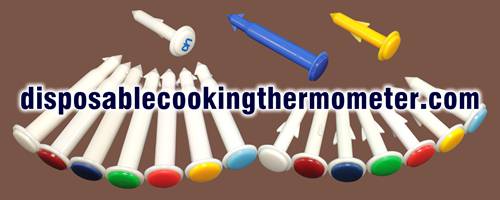
This is one reason why disposable pop-up cooking thermometers became widely adopted for many poultry products.
Rather than asking consumers to estimate doneness based on color or cooking time, the indicator converts internal temperature into a simple visual event.
The user does not need to interpret technical data. They simply observe the indicator as part of the normal cooking process.
Small Design Decisions Create Better Cooking Experiences
Successful food products often include features that quietly remove uncertainty without attracting much attention.
Consumers rarely think about easy-open packaging, resealable bags, or clear cooking instructions until they are missing.
Visual cooking indicators work in much the same way.
When properly engineered, they reduce guesswork without adding extra steps for the consumer.
The result is a smoother cooking experience rather than a more complicated one.
Why Engineering Precision Is Important
Converting temperature into a reliable visual signal requires considerably more engineering than many people realize.
Activation performance depends on the interaction of food-grade polymers, temperature-sensitive materials, precision springs, dimensional accuracy, and carefully controlled manufacturing processes.
Small variations during production can affect consistency, especially across large manufacturing volumes.
For this reason, specialized manufacturers place significant emphasis on calibration, material selection, and process control throughout production.
Helping Consumers Make Better Decisions
Ultimately, the purpose of modern food packaging is not only to protect the product but also to help consumers prepare it successfully.
Clear instructions, practical cooking guidance, and intuitive product features all contribute to a more confident cooking experience.
Visual indicators should not replace good cooking practices, but they can make those practices easier to follow.
By reducing uncertainty, manufacturers improve not only food preparation but also customer satisfaction and confidence in the finished product.
Looking Beyond Appearance
Appearance will always remain an important part of cooking.
A beautifully browned roast or golden poultry skin is naturally appealing and often signals that a meal is nearly ready.
But appearance tells only part of the story.
Modern food manufacturing increasingly focuses on measurable, repeatable indicators that help deliver consistent cooking results regardless of who prepares the meal or where it is cooked.
Understanding the limitations of visual doneness is one step toward designing food products that are not only enjoyable to eat but also easier and more reliable to prepare.